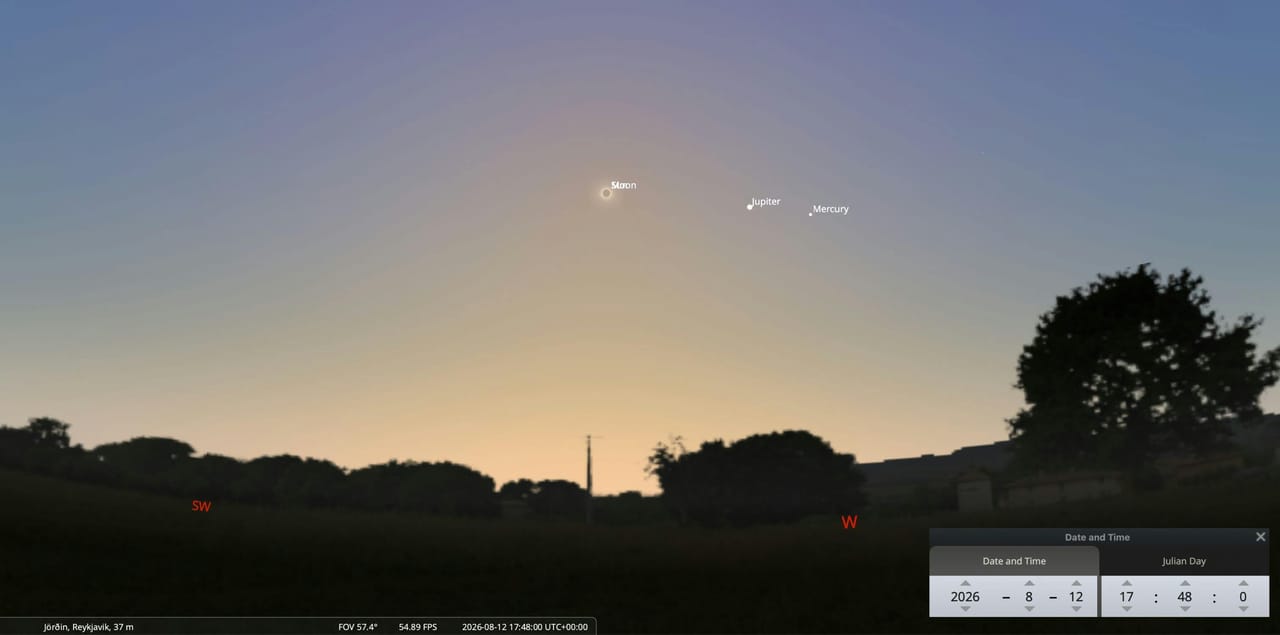
By observing the sun on April 30, 2026, planners and photographers in Iceland can use Earth's orbital symmetry to preview the exact sky position of the August 12 total solar eclipse.
What will you be doing at 5:48 p.m. on Thursday, 30 April 2026? If you’re preparing for the total solar eclipse on Wednesday, 12 August 2026, in Iceland, there’s only one place to be — outside, looking to the southwest to take advantage of a fascinating piece of celestial symmetry.
Although spring and late summer may feel worlds apart, these two days share a remarkable astronomical connection: they sit exactly 52 days on either side of the summer solstice.
Because of this symmetry in Earth’s orbit, the sun traces almost the same path across the sky on both dates.
For those planning to see the rare event in Iceland, the evening of 30 April (and the evenings either side) will therefore offer a preview of exactly where in the sky the moon will completely cover the sun in August — and help everyone avoid shadowed areas during totality.
The reason lies in a concept astronomers call solar declination — the angular position of the sun north or south of Earth’s equator. Throughout the year, the sun’s declination changes as Earth orbits the sun, and its tilted axis shifts the sun’s apparent position in the sky. The sun reaches its most northerly point at the summer solstice, which this year occurs on Sunday, 21 June.
Dates that fall the same number of days before and after the solstice share nearly identical solar declination.
The sun rises and sets in nearly the same locations.
The sun follows almost the same arc across the sky.
The solar altitude at the same time of day is nearly identical.
Since 30 April, 2026 is exactly 52 days before the solstice and 12 August, 2026 is 52 days after, the sun’s position in the sky is almost perfectly mirrored.
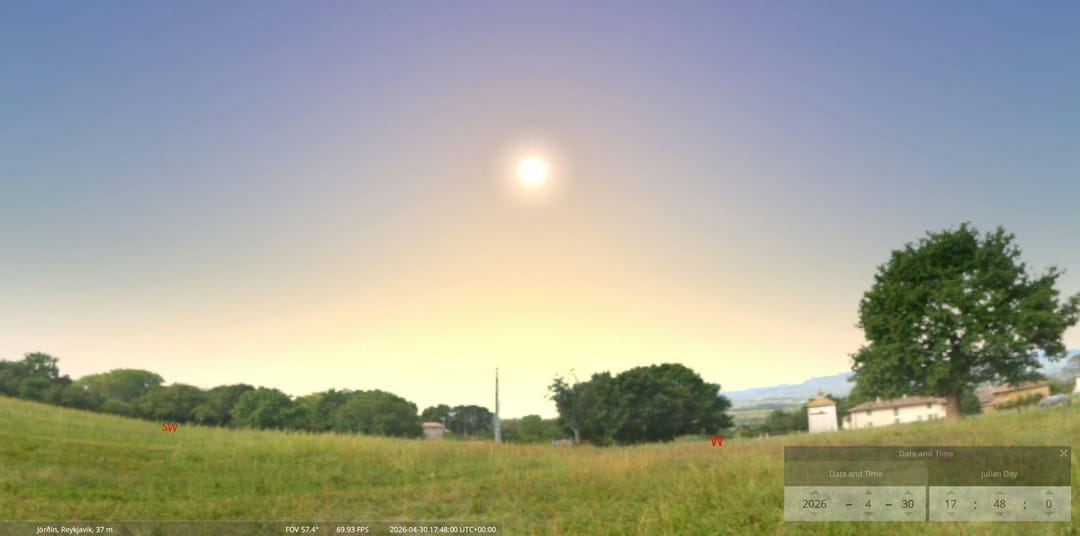
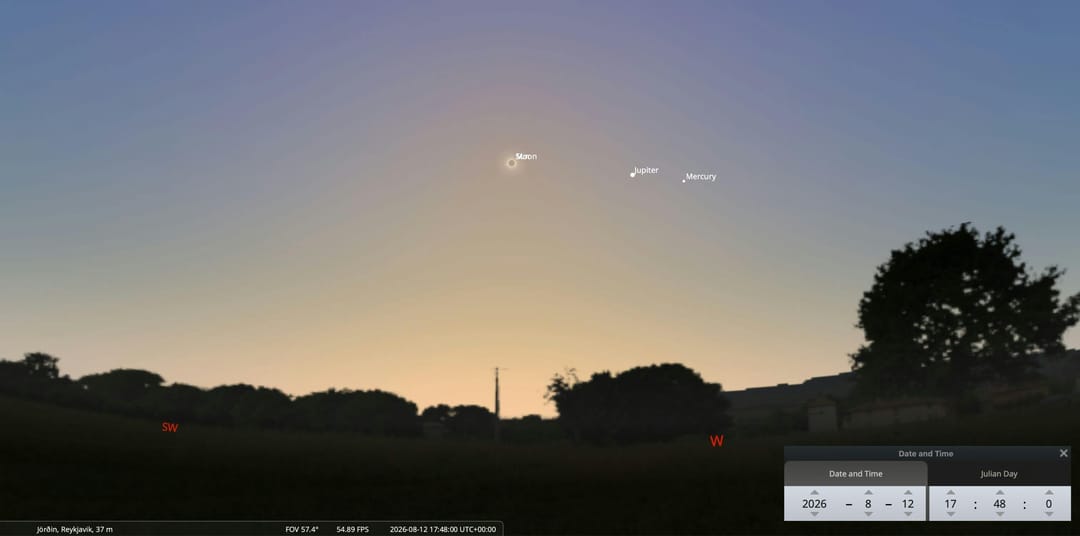
For observers hoping to experience the total solar eclipse from Iceland, this creates a rare opportunity. Looking at the sun on 30 April at the same time of day as the eclipse will occur gives a near-perfect preview of where the eclipsed sun will appear in the sky.
In Iceland, totality will occur when the sun is about 24.5° above the horizon in the southwest. That’s not especially high in the sky, which means the surrounding landscape could play an important role in how the event is seen. Hills, mountains, cliffs and buildings could partially block the view if observers aren’t careful about their location.
For the average observer, that detail might not seem critical. After all, the sun will still be comfortably above the horizon. But for those carefully planning where to watch from, it’s one of the most important factors in eclipse preparation. Knowing exactly where the sun will be allows people to choose locations with an unobstructed southwest view — something that can vary dramatically across Iceland’s rugged terrain.

For event planners, 30 April is an opportunity not to be missed. Iceland is expected to welcome thousands of eclipse visitors in 2026, and organizers planning viewing events can use it as a rehearsal. By checking the sun’s position that afternoon, planners can quickly see whether mountains, ridges or urban structures intrude on the sightline.
For example, in Reykjavík, observers will need a clear view toward the southwest over Faxaflói Bay. Waterfront areas, such as the harbor or open coastal viewpoints, offer wide horizons, but some inland streets may have their views partially blocked by buildings or rising terrain.

For photographers, 30 April provides an equally valuable test run. With the sun following nearly the identical path across the sky, photographers can experiment with composition, framing and foreground elements months before the eclipse.
Anyone wanting to, say, frame the eclipse alongside the spire of Hallgrímskirkja or above the Harpa Concert Hall in Reykjavík, or above the Búðakirkja in the Snæfellsnes Peninsula, should test their shot at 5:48 p.m. on 30 April.
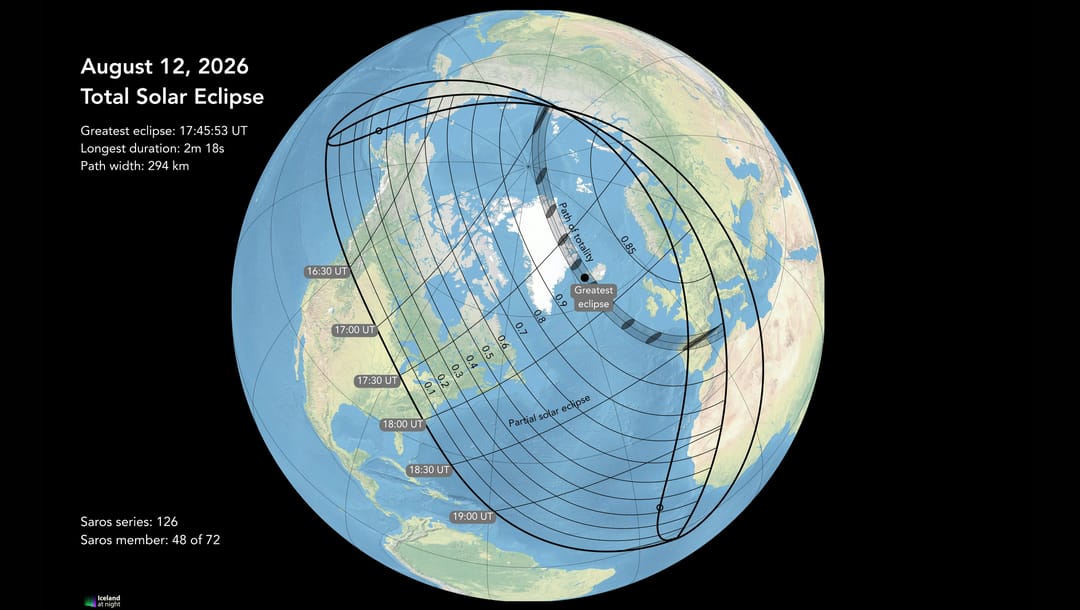
On 12 August 2026, a total solar eclipse will sweep across parts of the Arctic and the North Atlantic, with western parts of the Westfjords, Snæfellsnes Peninsula, Reykjanes Peninsula and Reykjavík within the path of totality. During totality, the moon will completely cover the sun, revealing the sun’s corona — its faint outer atmosphere — for a few minutes.
However, on 30 April, something rare in astronomy will occur: a practice eclipse sky. The elegant geometry of Earth’s orbit will quietly reveal exactly where the most dramatic moment of the 2026 total solar eclipse will unfold above Iceland — months before the moon actually slides across the sun.

Jamie Carter is the author of Complete Guide to the Total Solar Eclipse 2026, The Eclipse Effect and When Is The Next Eclipse? A traveler’s guide to total solar eclipses 2026-2034